skip to content

PUBLICATIONS

Research, field reports and essays on technology, territories and citizenship.

page 03 / 13 · 113 publications

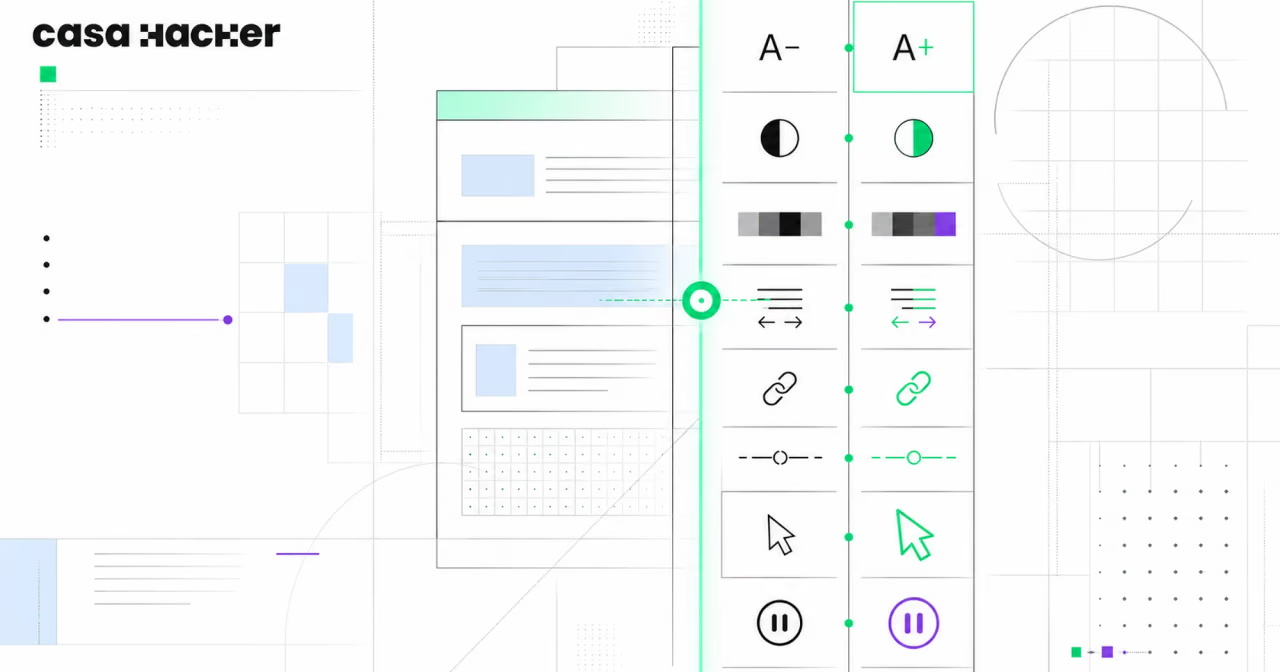
Illustration of the Casa Hacker accessibility bar: controls for font size, contrast, spacing, links, cursor, and animation pause, in two before-and-after columns, next to the sketch of a website page
Accessibility

Accessibility Bar: our open technology for inclusion

Casa Hacker open-sources its accessibility bar with a free license: the features we standardized across our platforms can now be used by any website — and the Casa Hacker website now speaks four languages.

Geraldo Barros
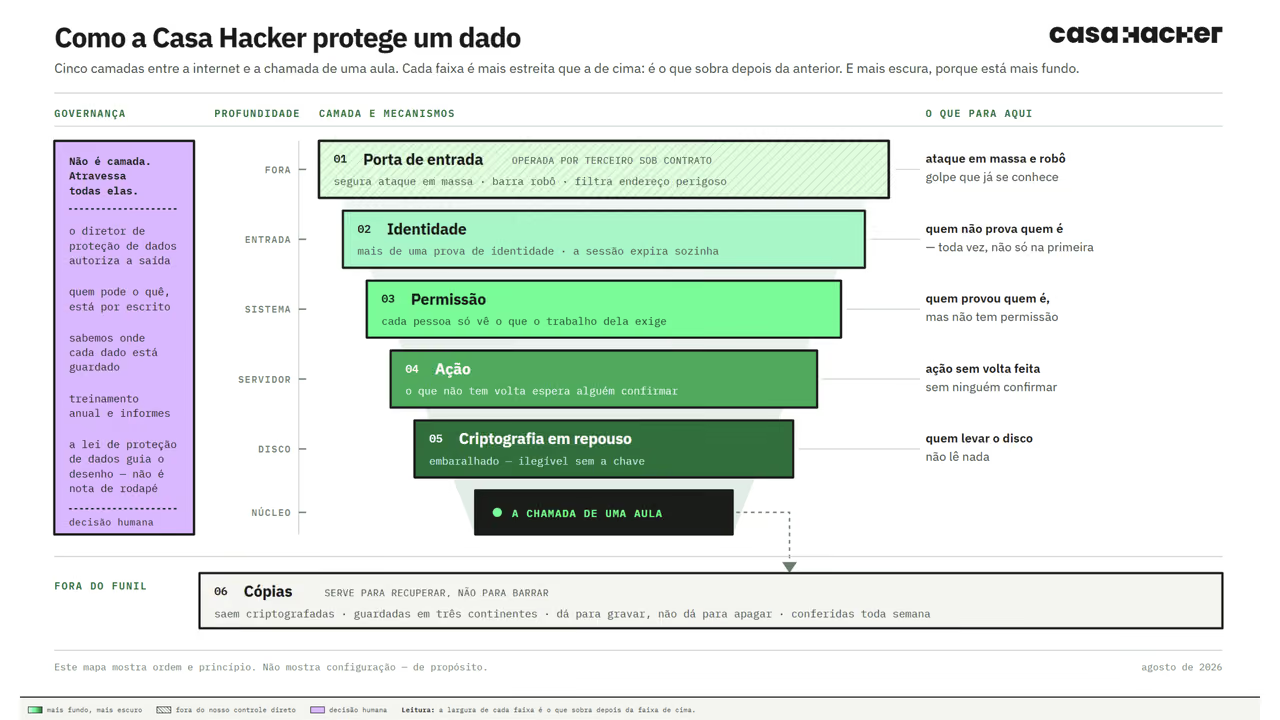
Diagram on a white background, titled "How Casa Hacker protects a piece of data", with the Casa Hacker wordmark in the top right corner. It shows five layers of protection stacked into a funnel: each band is narrower and darker than the one above, because it represents what survives the previous layer and how deep the data sits. An axis on the left names that depth — outside, entrance, system, server, disk and core. The first layer, Entry door, appears in very pale green with diagonal hatching, marking it as operated by a third party under contract: it absorbs mass attacks, blocks bots and filters dangerous addresses, and that is where mass attacks, bots and already-known exploits stop. The second, Identity, requires more than one proof of identity and lets the session expire on its own; there stops anyone who cannot prove who they are — every time, not only the first. The third, Permission, in the brand's vivid green, ensures each person sees only what their work requires; there stops anyone who proved who they are but has no permission. The fourth, Action, in mid green, makes anything irreversible wait for someone to confirm; there stops any irreversible action taken with nobody confirming. The fifth, Encryption at rest, in dark green, leaves the data scrambled and unreadable without the key; there stops anyone who takes the disk and reads nothing. At the bottom of the funnel, a black box with green text holds the protected data: "the attendance record of a class". On the left, a vertical purple band crosses every layer, marked "not a layer — it crosses them all": the data protection officer authorises every transfer out; who may do what is written down; we know where each piece of data is kept; there is annual training and ongoing briefings; and the data protection law guides the design rather than sitting in a footnote. Purple marks human decision. Below the funnel, separated by a line and labelled "outside the funnel", a grey band carries the sixth item, Copies, which serves to recover and not to block: they leave encrypted, are kept on three continents, can be written but not erased, and are checked every week. The footer reads: "This map shows order and principle. It does not show configuration — deliberately."
Institutional Development

Security at Casa Hacker: how we protect the data of those who trust us

Casa Hacker spent the past months hardening its platforms before letting artificial intelligence in. This is the account of what changed: what it means to say a piece of data is encrypted, why our copies leave the country every day and cannot be erased, how Project Galileo put enterprise-grade protection within reach of an organisation from the periphery, and why a single person authorises every data transfer out. It includes what we still don't do — because an organisation that only tells the finished part is asking you to believe it rather than check it.

Geraldo Barros
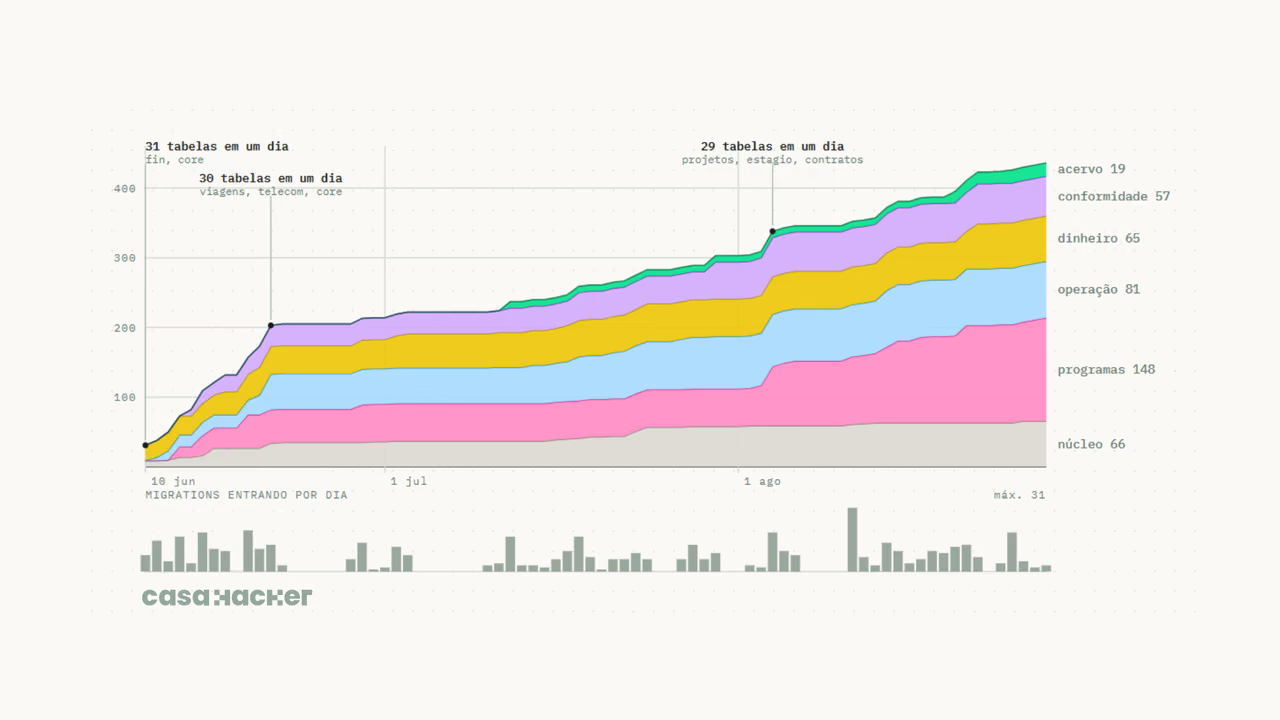
This image shows a stacked area chart on a light beige dotted background, illustrating the cumulative growth of data migrations over time for the "casa hacker" project. The main chart is divided into six coloured categories with their final volumes shown on the right: core (66, grey), programmes (148, pink), operations (81, blue), money (65, yellow), compliance (57, purple) and archive (19, green). The timeline, running from June to August, highlights three specific peaks of data insertion (with 31, 30 and 29 tables in a single day), while the lower part carries the caption "MIGRATIONS ARRIVING PER DAY" just above a grey bar chart showing the daily, intermittent frequency of these volumes.
Social Innovation

The AI that interests us does not answer email: what we did before asking artificial intelligence for a single answer

While the debate about AI splits between productivity tricks and grand promises of social impact, we decided to solve the problem that came first: our own database. This is the account of what we did in eight stages, of the mistakes that measurement disproved, of the privacy rules we did not negotiate. In the end, the base did become accessible to AI — an MCP server with 86 tools, live, without opening the database or loosening a single permission — and what remains are the questions about drop-out and welcome that our data still cannot answer.

Geraldo Barros

Donate

The link opens the BTG Pactual donation page, with the payment methods available there.

Donate in reais

From outside Brazil

For an international transfer, use the details below. Pick the currency: what changes between them is the intermediary bank.

The field names are in English because that is how they appear in your bank’s transfer form.

The same for both currencies

Creditor Agent (BICFI)BPABBRRJ
Creditor AgentBANCO BTG PACTUAL S.A.
Bank addressPraia de Botafogo, 501 — Rio de Janeiro — Brazil
IBAN / OtherBR8130306294000500002143176C1
BeneficiaryASSOCIACAO CASA HACKER
Beneficiary addressRua Doutor Renato Paes de Barros, 618 — Itaim Bibi — São Paulo — SP — 04530000 — Brasil

USD

Intermediary Agent (BICFI)CITIUS33
Intermediary AgentCITI, NEW YORK — US
BTG account with intermediary36317173

EUR

Intermediary Agent (BICFI)CHASDEFX
Intermediary AgentJP MORGAN FRANKFURT — DE
BTG account with intermediary6231431278

Remittance Information is optional: use it to identify the payment if you want to.

Check the details on your bank’s screen before confirming the transfer.

see the full page →